The bottom line The neatest installation in the hub and the right approach to limescale for a kettle. Its bacteria claim carries no standard, and its cartridge sees every litre the tap pours.
What you are getting
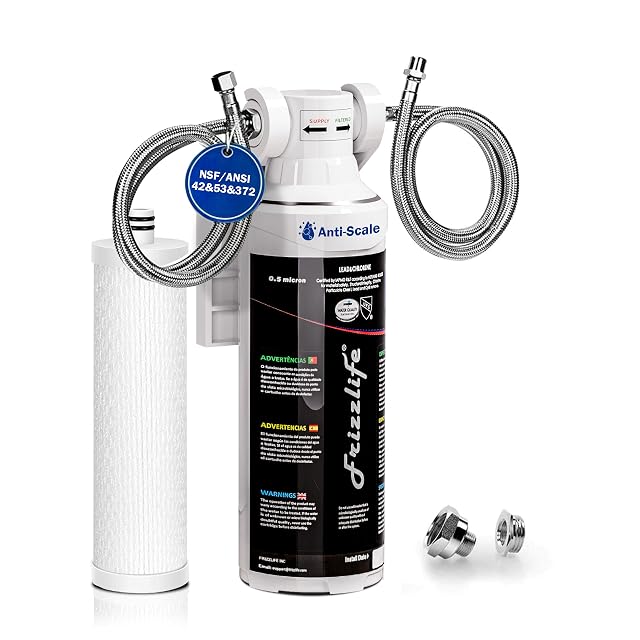
A three-stage inline water filter — a 0.5 µm sediment stage, an activated carbon block, and a limescale crystallisation stage — connecting between your cold water line and your existing tap, with a stated capacity of 3 500 litres or about six months and a five-minute installation.
No second tap
Every other under-sink filter in this catalogue either needs its own small tap on the worktop or diverts a line to one.
This one goes in front of the tap you already have. No hole cut in a stone worktop, no second spout beside the mixer. In a finished kitchen that is the difference between fitting a filter and deciding not to.
The consequence: it filters everything that tap pours, including the water you use to fill a saucepan. The cartridge sees all of it, which is part of why it lasts 3 500 litres rather than 40 000.
Crystallisation is not softening
The maker is clear about the mechanism and this page will be too: the calcium stays in the water. What changes is its form — crystals that do not adhere, stated as stable up to 200 °C, which is the temperature that matters inside a kettle.
That protects your appliances. It is a different job from an ion-exchange softener, which removes the calcium and needs salt to do it.
The claim without a standard
The maker states the 0.5 µm sediment stage removes bacteria, sand and rust.
A half-micron filter will physically retain many bacteria by size. No test standard, protocol or certification is named for the claim here, and two filters in this hub cite NSF/ANSI or IAPMO. Reported as stated.
The sustainable part, which is real
Only the medium is replaced, not the housing. Most cartridges are a plastic shell thrown away with the carbon inside it. This is a genuine reduction in both waste and running cost.
Availability
On sale at around 80 € on the German Amazon store at the time of checking.
Listed but with no offer on the French, Italian and Spanish Amazon stores — the reference exists there and nobody is currently selling it.
Not found on the American and British Amazon stores, where the buy link falls back to a local search rather than to a page that does not exist.
Prices and availability are what Keepa reported on the date this page was updated; both move.
Prices quoted in this text were read on 5 September 2026. The live price is at the top of the page.
What we like, and what we don't
Strengths
No separate filter tap and no new hole in the worktop — it feeds the tap you already have
Only the filter medium is replaced, not the whole plastic housing, which is a genuine reduction in waste and cost
States that the crystallised limescale stays stable to 200 °C, which is the temperature it has to survive in a kettle
Compromises
Crystallisation does not remove limescale from the water — it changes how it behaves, and the distinction matters
The maker states the 0.5 µm stage removes bacteria; no test standard or certification is named for that claim
No connection size and no flow rate, and filtering everything the tap delivers means the cartridge sees all of it
Specifications
Filter type
Three-stage inline: a 0.5 µm sediment stage, an activated carbon block, and a limescale crystallisation stage — stated
Stated capacity
Up to 3 500 litres or about six months — stated
Declared reductions
The maker states that the 0.5 µm sediment stage removes bacteria, sand and rust, that the carbon block filters inorganic substances such as chlorine, and that limescale is crystallised rather than removed; it states that all minerals are retained
Connection size
Not stated as a figure — the filter is stated to connect between the cold water line and your existing tap
Stated flow rate
Not stated by the maker
Cartridge
Only the worn filter medium is replaced, not the housing — stated, with a quick-change fitting and a five-minute installation
Amazon reference
B0H4M82QQF (same reference on 4 Amazon marketplaces)
EAN
4255665401181
Questions people actually ask
Does crystallisation remove limescale?
No, and the maker does not claim it does. The calcium stays in the water; the technology changes the form it takes so it does not adhere to surfaces. That protects a kettle and a coffee machine. It is a different thing from an ion-exchange softener, which actually takes the calcium out.
Does it really remove bacteria?
The maker states that the 0.5 µm sediment stage does. A 0.5 micron filter will physically retain many bacteria by size, and no test standard or certification is named here for the claim. This page reports what the maker states and does not present it as a verified finding — two other filters in this hub cite named standards.
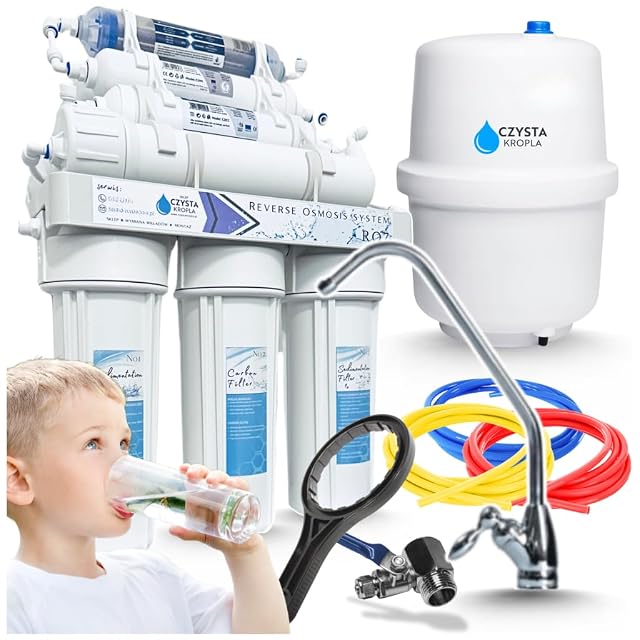
Reverse osmosis · seven stages · 75 GPD membrane, up to 270 litres a day · separation to 0.0001 µm stated · 12-litre storage tank · remineralisation with calcium and magnesium · improved waste ratio, unquantified
The only reverse osmosis system here — the one technology that genuinely lowers TDS — with a remineralisation stage to put minerals back afterwards.
Best for: A household that wants dissolved solids genuinely reduced, with cupboard room for a tank and a tolerance for waste water.
Under-sink filter · two-stage 0.5 µm · NSF/ANSI 42 and 53 certified · over 7.57 l/min at 40 psi stated · fits 1/2 in and 3/8 in cold lines · shut-off built into the cap · does NOT reduce TDS, stated
The only filter in this catalogue that publishes a flow rate with the pressure behind it, cites two NSF/ANSI standards, and states in its own listing what it does not do.
Best for: A kitchen with cupboard space, where the specification should be checkable against a named standard.
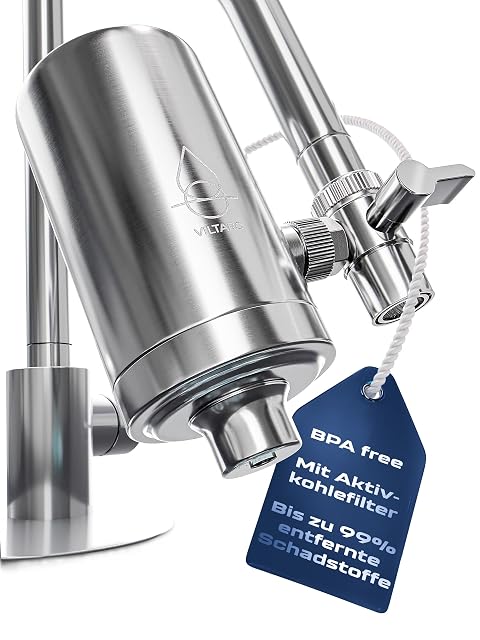
Tap filter · coconut-shell carbon block with anti-limescale granulate · 4 µm fineness · up to 3 000 litres or 4 months · M22 male / M24 female with adapters · diverter lever in stainless
The only filter here that screws onto the tap itself rather than living under the sink — with a stainless diverter lever and a published 4 µm fineness.
Best for: A rented flat, or a kitchen with no cupboard space under the sink, where the filter has to come with you.