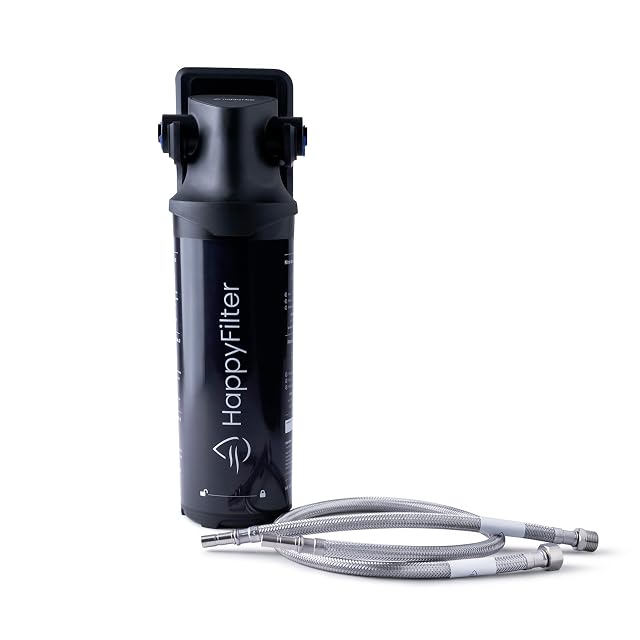
The bottom line The only system here that does what the others say they do not. It publishes its membrane and its output, and nothing at all about its running cost or its waste.
What you are getting
A seven-stage reverse osmosis system with multi-stage pre-filters, a 75 GPD membrane stated to separate dissolved substances down to 0.0001 micrometres, post-filtration with calcium and magnesium remineralisation, a 12-litre storage tank, and a complete installation set with pre-assembled colour-coded lines.
What reverse osmosis actually is
The carbon filters in this hub work by size and adsorption, and two of them state in their own listings that they do not reduce TDS.
Reverse osmosis pushes water through a membrane that rejects dissolved solids too. That is why it needs a tank, why the output is measured per day rather than per minute, and why it is the only system here that changes what is dissolved in your water.
The remineralisation stage
RO water comes through stripped of the calcium and magnesium that give water its taste. This system adds them back in dedicated cartridges afterwards.
That is the standard answer to the standard complaint about RO water, and it is stated rather than implied.
The number that is missing, and it is the important one
The waste water ratio.
Every RO system sends water to the drain to flush the membrane. Some send four litres for every one produced; better ones send far less.
The maker states an “improved waste water ratio” — improved from what, to what, is never said. On a metered supply that figure is the running cost. Ask the seller before ordering.
And the other running cost
Seven stages, no cartridge lives. Pre-filters, membrane, post-filters and remineralisation cartridges all have replacement intervals, and none of them is published. Two filters in this hub state theirs in litres and months.
Availability
On sale from 145 € to 150 € on the German, French, Italian and Spanish Amazon stores at the time of checking.
Listed but with no offer on the American Amazon store — the reference exists there and nobody is currently selling it.
Not found on the British Amazon store, where the buy link falls back to a local search rather than to a page that does not exist.
Prices and availability are what Keepa reported on the date this page was updated; both move.
Prices quoted in this text were read on 5 September 2026. The live price is at the top of the page.
What we like, and what we don't
Strengths
Reverse osmosis is the one technology here that genuinely reduces dissolved solids — the others state that they do not
A remineralisation stage adding calcium and magnesium back after the membrane, which is what RO water otherwise lacks
A complete installation set with pre-assembled lines and colour-coded connections, aimed at retrofitting a finished kitchen
Compromises
Reverse osmosis sends water to the drain, and the improved ratio the maker claims is never quantified
No cartridge lives or replacement intervals for any of the seven stages — the running cost cannot be worked out
A 12-litre tank plus the unit needs real cupboard space, and no dimensions are published
Specifications
Filter type
Seven-stage reverse osmosis: multi-stage pre-filters, a 75 GPD membrane, and post-filtration with remineralisation — stated
Stated capacity
Up to 270 litres a day from a 75 GPD membrane, with a 12-litre storage tank — stated
Declared reductions
The maker states significant reduction of heavy metals, chlorine, turbidity, microcontaminants and odours, with separation of dissolved substances down to 0.0001 micrometres; no test standard is named
Connection size
Not stated as a figure — a complete installation set with pre-assembled lines and colour-coded connections is supplied
Stated flow rate
Not stated as a rate — output is given per day rather than per minute, which is how a tank-fed system works
Cartridge
Multiple cartridges across seven stages including remineralisation; no individual lives or replacement intervals are stated
Amazon reference
B0GT5RQD6B (same reference on 5 Amazon marketplaces)
EAN
5907246681657
Questions people actually ask
How is reverse osmosis different from the other filters here?
The carbon filters in this hub catch things by size and adsorption, and two of them state plainly that they do not reduce TDS. Reverse osmosis forces water through a membrane that rejects dissolved solids as well — which is why it needs a pump, a tank and a drain line, and why it is the only one here that changes what is dissolved in the water.
How much water does it waste?
That is the question this listing does not answer. Every RO system sends some water to the drain, and the ratio is the number that matters. The maker states an "improved waste water ratio" without saying improved from what, or to what. Ask before buying, especially if your water is metered.
Inline filter · three stages: 0.5 µm sediment, carbon block, limescale crystallisation stable to 200 °C · up to 3 500 litres or about 6 months · fits between the cold line and your existing tap · only the medium is replaced
An inline filter that needs no second tap and no new hole in the worktop — it goes between your cold supply and the tap you already have.
Best for: A kitchen where limescale on the kettle and the coffee machine is the problem, and where a second tap is not an option.
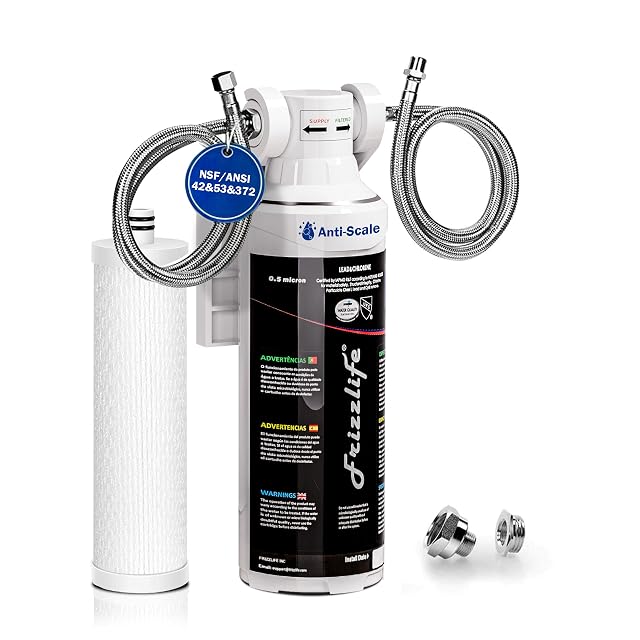
Under-sink filter · two-stage 0.5 µm · NSF/ANSI 42 and 53 certified · over 7.57 l/min at 40 psi stated · fits 1/2 in and 3/8 in cold lines · shut-off built into the cap · does NOT reduce TDS, stated
The only filter in this catalogue that publishes a flow rate with the pressure behind it, cites two NSF/ANSI standards, and states in its own listing what it does not do.
Best for: A kitchen with cupboard space, where the specification should be checkable against a named standard.
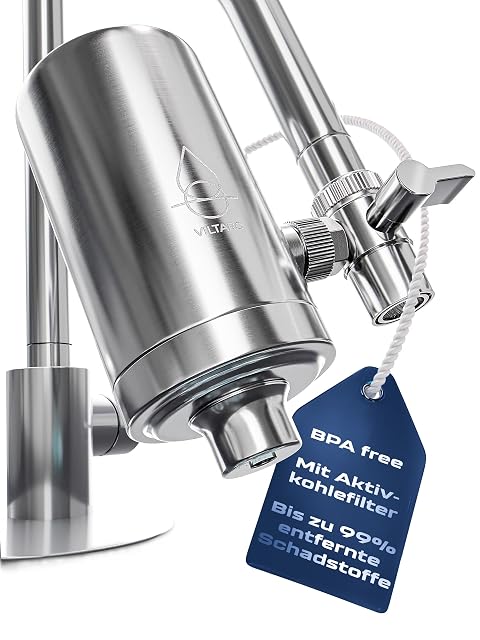
Tap filter · coconut-shell carbon block with anti-limescale granulate · 4 µm fineness · up to 3 000 litres or 4 months · M22 male / M24 female with adapters · diverter lever in stainless
The only filter here that screws onto the tap itself rather than living under the sink — with a stainless diverter lever and a published 4 µm fineness.
Best for: A rented flat, or a kitchen with no cupboard space under the sink, where the filter has to come with you.