The bottom line The softener you can size against your own water report, and the only one here whose headline figure means something. Its skin and hair claims stay the maker's.
What you are getting
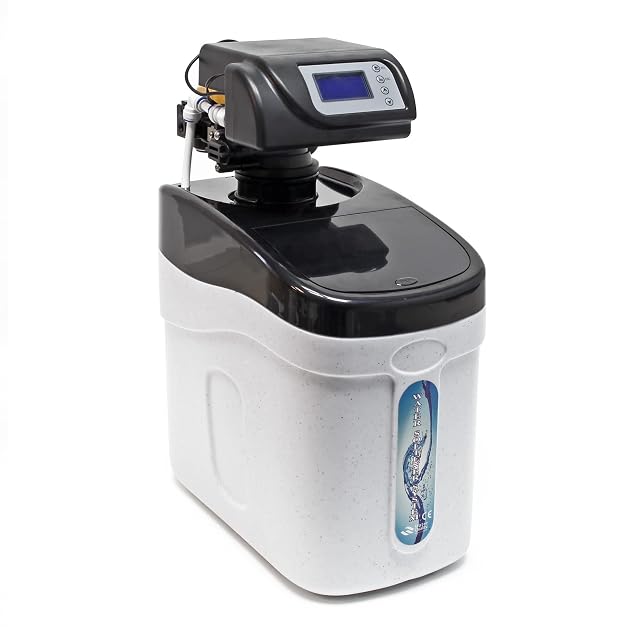
A metered water softening system stated for households of up to five people, treating up to 4 800 litres per regeneration cycle at 10 °dH, with a BNT 1650 electronic valve and integrated water meter, automatic regeneration at 02:00 lasting about 30 minutes, and a complete 1 in connection set with a mounting block.
The figure that is written correctly
“Up to 4 800 litres per regeneration cycle at 10 °dH.”
That last clause is the whole point. A softener’s capacity is used up by hardness, not by volume: the same resin that handles 4 800 litres of 10 °dH water handles roughly half as much at 20 °dH.
Find your water hardness on your water company’s website, and this figure tells you how often the unit will regenerate. No other softener in this catalogue lets you do that arithmetic.
Metering beats a timer
The valve counts what has actually passed through and regenerates when the resin is spent. A timer-controlled softener regenerates on schedule whether the house was empty or not — salt and water down the drain every week you were away.
The connection set, included
1 in, with the mounting block. On a whole-house softener that is a real cost and a real delay when it is missing. Here it is in the box.
The claims this page reports rather than repeats
The maker states “noticeably softer skin and smoother hair”.
That is the manufacturer’s conclusion about what softened water does to people. This site does not restate it as a finding.
What is demonstrable, and what the 4 800 litres figure is actually about: less limescale on your fittings, in your kettle and inside your boiler.
Availability
On sale from 563 € to 594 € on the German, French, Italian and Spanish Amazon stores at the time of checking.
Listed but with no offer on the British Amazon store — the reference exists there and nobody is currently selling it.
Not found on the American Amazon store, where the buy link falls back to a local search rather than to a page that does not exist.
Prices and availability are what Keepa reported on the date this page was updated; both move.
Prices quoted in this text were read on 5 September 2026. The live price is at the top of the page.
What we like, and what we don't
Strengths
Publishes 4 800 litres per cycle AND the 10 °dH it applies at — the only capacity figure in this catalogue with its reference attached
Metered regeneration on actual consumption rather than a timer, so salt is not wasted on a week away
The 1 in connection set and mounting block are supplied, so the installation needs nothing else
Compromises
No resin volume, no salt consumption and no footprint published
The maker states noticeably softer skin and smoother hair — claims this page reports and does not repeat
Nearly twice the price of the softener beside it in this hub
Specifications
Resin volume
Not stated by the maker
Stated capacity between regenerations
Up to 4 800 litres per regeneration cycle at 10 °dH — stated, with the reference hardness
Regeneration type
Volume-controlled: a BNT 1650 electronic valve with a built-in water meter measures actual consumption; regeneration starts automatically at 02:00 and takes about 30 minutes — stated
Connection size
1 in, with the complete connection set and mounting block supplied — stated
Stated salt consumption
Not stated by the maker
Footprint
Not stated by the maker — the maker states it is sized for households of up to five people
Amazon reference
B09LR5JYFS (same reference on 5 Amazon marketplaces)
EAN
4872313136587
Questions people actually ask
Why does the capacity need a hardness attached to it?
Because a softener's capacity is consumed by hardness, not by volume. The same unit that treats 4 800 litres at 10 °dH treats roughly half that at 20 °dH. A capacity published without its reference hardness is not a specification — and this is the only one in this catalogue that carries one.
What is metered regeneration?
A water meter in the valve counts what has actually passed through, and regeneration happens when the resin is genuinely exhausted. The alternative is a timer, which regenerates on a schedule whether you were at home or not — wasting salt and water every time.
Water softener · ion exchange · 500 l/h maximum flow · 1.5–5 bar operating pressure · brine tank for 10 kg of salt · hardness set on a display
An entry-level ion-exchange softener that publishes its flow and its operating pressure — and makes a claim about health that this page does not repeat.
Best for: A small household or a single appliance line in a hard-water area, where the budget will not stretch to a metered unit.
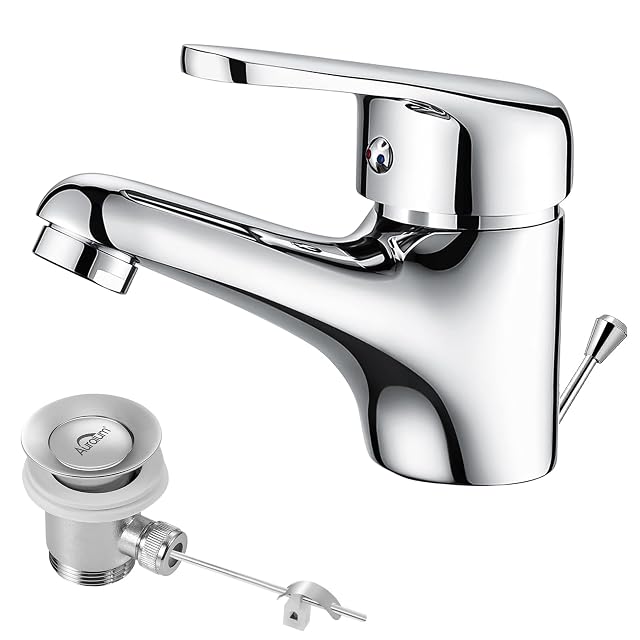
A basin mixer supplied with a solid brass rod waste and a cartridge the maker states has passed 500 000 cycles — the tap on this page that arrives most complete.
Best for: Replacing a tap and a tired waste at the same time, on a basin that has an overflow.
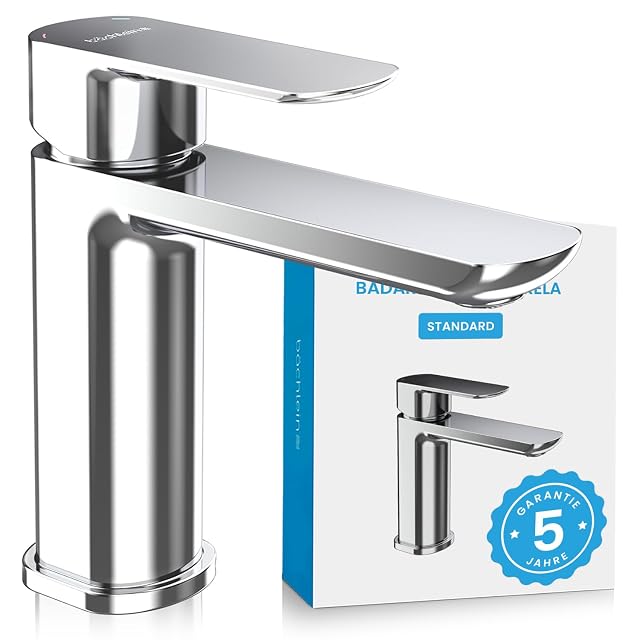
Basin mixer · ceramic cartridge · replaceable aerator · two DVGW-tested 50 cm G3/8 hoses · 5-year warranty stated
A chrome basin mixer sold as a complete, tested set: a ceramic cartridge, a replaceable aerator, two certified 50 cm hoses and a five-year manufacturer warranty.
Best for: A shallow inset basin where a flat spout suits, and where certified hoses and a long warranty are worth the premium.