The bottom line The thermostat to buy when the setting should stay set. The plastic handle is an argued choice rather than a saving, and the pressure figure is still missing.
What you are getting
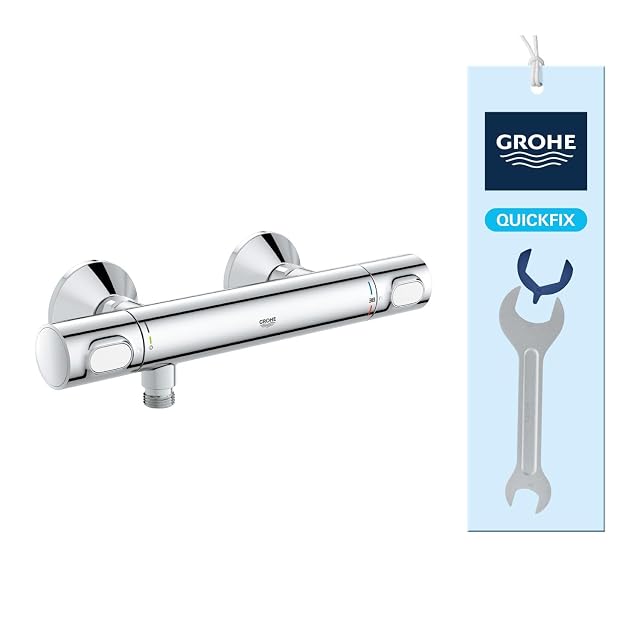
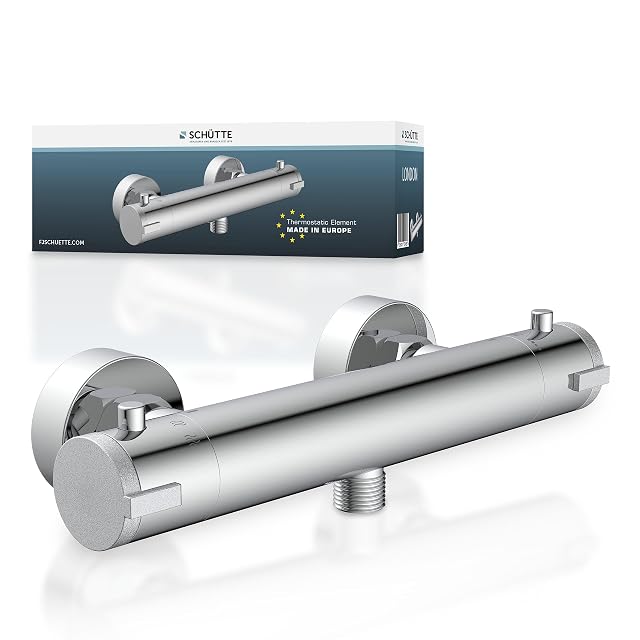
A chrome surface-mounted shower thermostat with hot and cold connections 150 mm apart, a lockable 38 °C safety button, a separate flow handle and an outlet that takes any common shower hose.
The lock is the feature
Most thermostats on this shelf have a detent — a click the hand feels, released by pressing a button. This one can be locked with a key, so the limit is not passed by someone leaning on the handle. In a house with children that is a real difference.
It remains a temperature limit, not a scald-prevention device. Where genuine scald prevention is required, the device that provides it is a thermostatic mixing valve specified for the job.
The plastic handle, argued rather than hidden
The maker states two reasons: limescale seizes metal spindles, and metal is cold to hold in winter. Both are true, and it is unusual to see a maker defend a plastic part instead of ignoring it.
It is still the part your hand pulls on every day.
What is not published
Minimum operating pressure. On a thermostat, that is the figure that decides whether it holds a temperature on your system at all.
Availability
On sale from 50 € to 57 € on the German, French, Italian and Spanish Amazon stores at the time of checking.
Also on sale on the British Amazon store, in the local currency: the range above is measured on the euro stores only.
Not found on the American Amazon store, where the buy link falls back to a local search rather than to a page that does not exist.
Prices and availability are what Keepa reported on the date this page was updated; both move.
Prices quoted in this text were read on 5 September 2026. The live price is at the top of the page.
What we like, and what we don't
Strengths
Publishes a 150 mm centre distance and states that any standard shower hose connects to the outlet
The 38 °C button can be locked, which is a genuine difference from a detent that only clicks
A plastic handle, stated as resisting limescale seizure and as less cold to the touch in winter
Compromises
A plastic handle is still plastic, and it is the part a hand pulls on every day
No minimum operating pressure, so behaviour on a low-pressure system is unknown
The flow control is a separate left-hand handle, which some people find slower than a single lever
Specifications
Centre distance
150 mm between the hot and cold connections — stated
Minimum operating pressure
Not stated by the maker
Temperature stop
38 °C safety button, lockable with a key — stated
Cartridge
Thermostatic cartridge — stated; type and diameter not given
Outlets
One outlet, stated to take any common shower hose
Finish
Chrome — stated
Amazon reference
B0FFSWJBM3 (same reference on 5 Amazon marketplaces)
EAN
6979430721165
Questions people actually ask
What does locking the button do?
It fixes the limit so it cannot be pushed past casually. A detent that only clicks is released by anyone leaning on the handle; a lockable one takes a deliberate action. That is a real difference in a house with children.
Is a plastic handle a compromise?
It is, and the maker argues its side: metal handles seize with limescale around the spindle and are cold to hold. Both are true. It is also the part your hand pulls on daily, and plastic is where that eventually shows.
Shower thermostat · TurboStat cartridge · 38 °C detent · EcoJoy flow limiting with a release button · S-connections and metal rosettes
A thermostat built around a flow-limiting button you press to release full flow — and a water-saving claim published as a percentage with nothing behind it.
Best for: A household that wants a lower default flow without having to think about it, on a known standard wall installation.
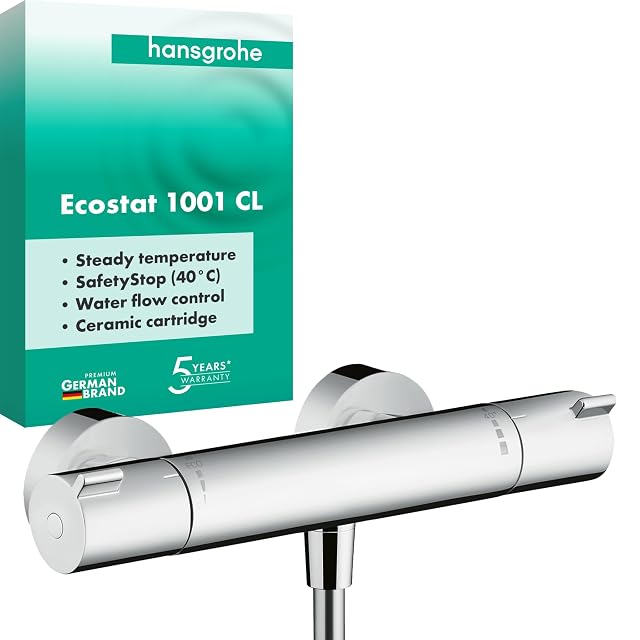
Shower thermostat · 150 mm ±12 centres · G1/2 DN15 · SafetyStop 40 °C · EcoStop 10 l/min first position · silencer fitted
A thermostat that publishes its centre distance with a tolerance, its limited flow in litres per minute, and a built-in silencer — three things nothing else on this page states.
Best for: An existing wall installation whose centres are close to but not exactly 150 mm, in a bathroom where shower noise carries.