What the maker puts in writing
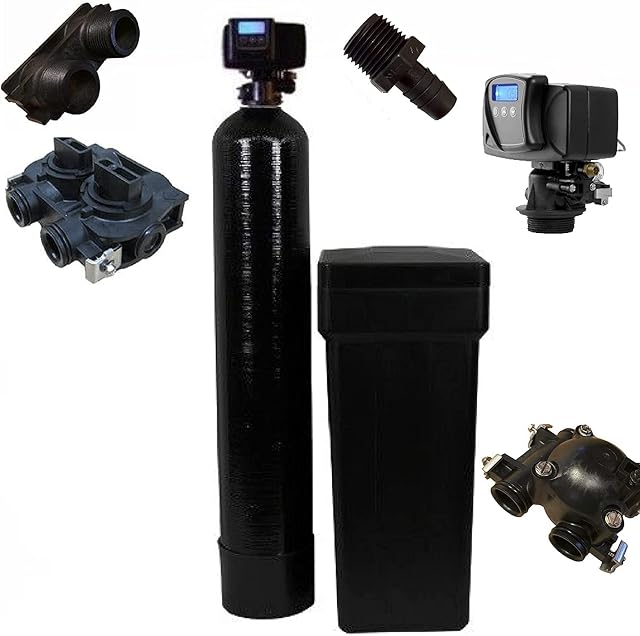
- Perfectly designed for 3-4 bathrooms; professional grade, delivering ultra-softened water to every outlet
- “Rated to treat 48,000 Grains of hardness by removing skin damaging hard minerals like calcium and magnesium… Triple Purpose Sediment/Carbon/Zinc pre-filter effectively removes 99% of water contaminants such as chlorine, VOCs, pesticides, bad odors, taste, soil, silt, sand, rust, heavy metals, and sediment”
- Eliminates scale buildup, preventing damage to plumbing and prolonging appliance life
- An automatic digital metered control head with a fully programmable backlit display for custom auto-flush intervals
- A high-strength, corrosion-resistant, fiberglass-lined polyethylene tank, a durable bypass valve and prefilled premium-grade resin; 30-day money-back, 5-year extended warranty and lifetime US tech support on activation online within 60 days
The pre-filter is the reason to pick this one
Not for the drinking water. For the resin.
Municipal water is chlorinated, and chlorine slowly oxidizes the resin beads that do the softening. They swell, soften and lose capacity — which is why a softener on city water does not last as long as one on a well.
A carbon pre-filter removes the chlorine before it reaches the bed. That is a direct extension of the softener’s working life, and it is a better reason to buy this than the long list of contaminants in the same bullet.
AFWFilters, on this shelf, solves the identical problem from the other end: 10% crosslink resin instead of the standard 8%, for chlorine resistance. Those are the two real answers to the problem. Eight listings here address it not at all.
Thirteen dollars twelve
Against $16.35 for Aquasure’s 32,000-grain unit and $19.97 for the GE.
And against $11.72 for Aquasure’s own 64,000-grain model — which is better value per grain and comes without a pre-filter.
So the choice within the range is clear: this for chlorinated city water, the 64,000 for a well or for more capacity.
Sixty-two inches
One thousand five hundred and seventy-five millimeters, which makes this the tallest system on this shelf.
And that is the tank alone. A softener needs headroom above it to lift the control head off for service.
The cabinet-style units here — Aquasana, Kenmore, EcoPure, GE — stand between 42.8 and 48 in (1,086 to 1,219 mm). PRO+AQUA is 36 in (914 mm) and weighs a hundred kilograms.
Measure the ceiling before the water.
The claim that is not a measurement
Removes 99% of water contaminants.
Eleven categories named, one percentage, no standard cited.
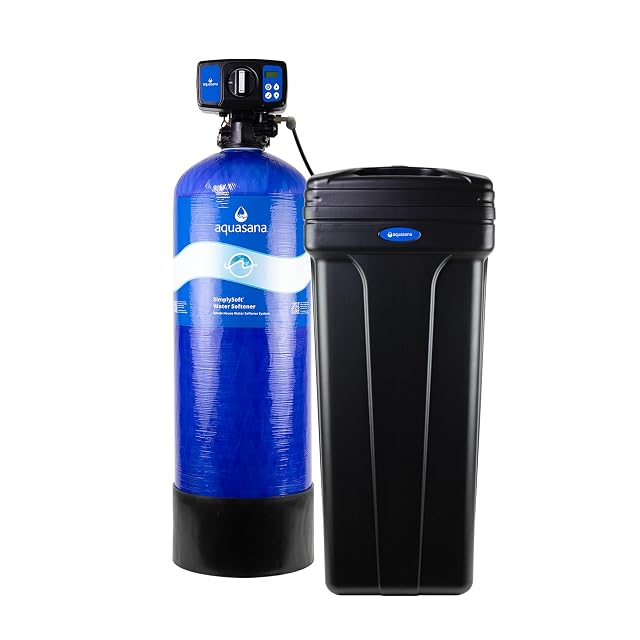
A sediment, carbon and zinc cartridge really will do most of that. But on this shelf two Aquasana softeners publish IAPMO certification to NSF/ANSI Standard 44 — the American standard for cation exchange softeners.
Aquasure publishes no certification on any of its five listings here.
Availability
Available at around $629.99 on Amazon.com when we checked on October 29, 2026, for delivery to a US address.
Stock and prices on Amazon.com move without notice; the button above opens the live listing.
Prices quoted in this text were read on October 29, 2026. The live price is at the top of the page.
The questions we get
Why does a pre-filter matter on a softener?
Because chlorine destroys the resin. Municipal water is chlorinated, and chlorine slowly oxidizes the polystyrene beads that do the softening — they soften, swell, and lose capacity. A carbon pre-filter removes chlorine before it reaches the resin bed, which directly lengthens the softener’s working life. AFWFilters, on this shelf, addresses the same problem from the other direction, with 10% crosslink resin instead of the standard 8% for better chlorine resistance. Those are the two legitimate answers, and this is one of only two Aquasure models here that includes a filter.
Is "99% of contaminants" a meaningful claim?
It is a long list without a test behind it. The bullet names chlorine, VOCs, pesticides, odors, taste, soil, silt, sand, rust, heavy metals and sediment — eleven categories, one percentage, no standard cited. By contrast the two Aquasana softeners on this shelf publish IAPMO certification to NSF/ANSI Standard 44, which is the actual American standard for softeners. A sediment, carbon and zinc cartridge will genuinely do most of what the bullet claims; the percentage is not a measurement.
Will sixty-two inches fit?
Measure first, because this is the tallest system on this shelf by some margin. One thousand five hundred and seventy-five millimeters is the tank height alone, and a softener needs clearance above it to lift the control head off for service. In a basement with eight-foot ceilings, fine. Under a stair or in a crawl space, no — and the cabinet-style softeners here (Aquasana, Kenmore, EcoPure, GE) are 42.8 to 48 in (1,086 to 1,219 mm), with PRO+AQUA shortest at 36 in (914 mm).