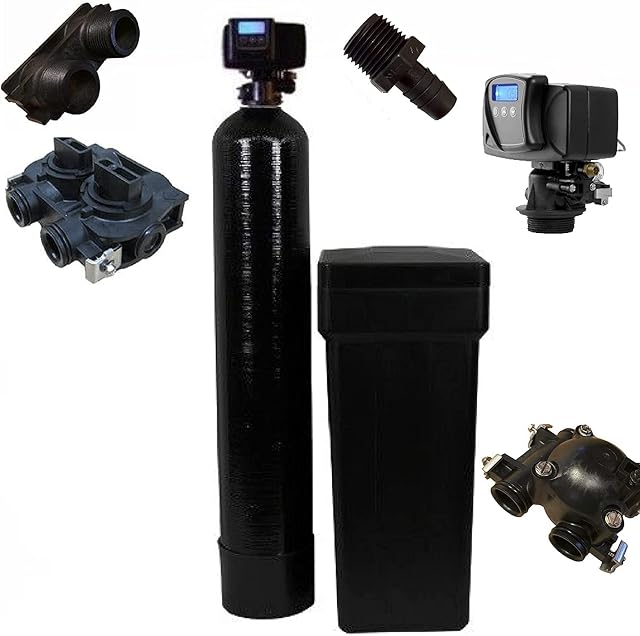
What the maker puts in writing
- Professional grade, rated to treat 50,000 grains of water hardness, for 3-4 bathrooms and up to 5 people
- “The Triple Purpose Sediment/GAC/Zinc Pre-Filter removes 99% of harmful contaminants such as chlorine, VOCs, PFAs, bad odors, taste, soil, silt, sand, rust, sediment, and more”
- Eliminates scale buildup while preventing damage to plumbing and prolonging appliance life
- An automatic digital metered control valve with a fully programmable backlit display; “allows precise backwashing only when it’s needed, saving hundreds of gallons of water”
- “Constructed with a high-strength, corrosion-resistant, stainless steel, durable bypass valve, and prefilled premium-grade resin”; 30-day money-back, 5-year extended warranty, lifetime US tech support on activation within 60 days
PFAs, named
That is the one word on this page that appears nowhere else on this shelf.
Per- and polyfluoroalkyl substances are the persistent industrial chemicals that have driven American drinking-water regulation in recent years, and granular activated carbon — the GAC in this pre-filter — is one of the accepted treatments for them.
Aquasure’s own 48,000-grain model lists chlorine, VOCs and pesticides in the same position and does not mention PFAs.
One clarification the page does not make: the pre-filter does that work, not the softener. Ion exchange removes calcium and magnesium. It does nothing to organic chemicals.
Three hundred and fifty-six millimeters shorter
48 in (1219 mm), against 62 in (1575 mm) for the maker’s 48,000-grain unit — with two thousand grains more capacity.
That is the quiet reason to prefer this model. A softener needs clearance above the tank to pull the control head for service, and the difference between 48 inches and 62 inches of tank is the difference between fitting under a joist and not.
Among the four Aquasures here, this is the short one.
Thirteen dollars sixty
32,000 — $16.35 per thousand. 48,000 — $13.12. 50,000 — $13.60. 64,000 — $11.72.
So this is not the value pick within Aquasure’s own range; the 64,000-grain unit is, and it is $70 more for 14,000 extra grains.
What this has that the 64,000 does not: the pre-filter, which protects the resin against chlorine, and three hundred millimeters of headroom.
A word that changed, and a number that did not appear
Aquasure’s other three Harmony listings here say fiberglass-lined polyethylene tank. This one says stainless steel.
A stainless jacket over a composite tank is normal at this level, and the listing does not say which part is steel. Fiberglass-lined polyethylene is also entirely good construction for a softener. It is a change of words that may not be a change of product — worth asking before paying for it.
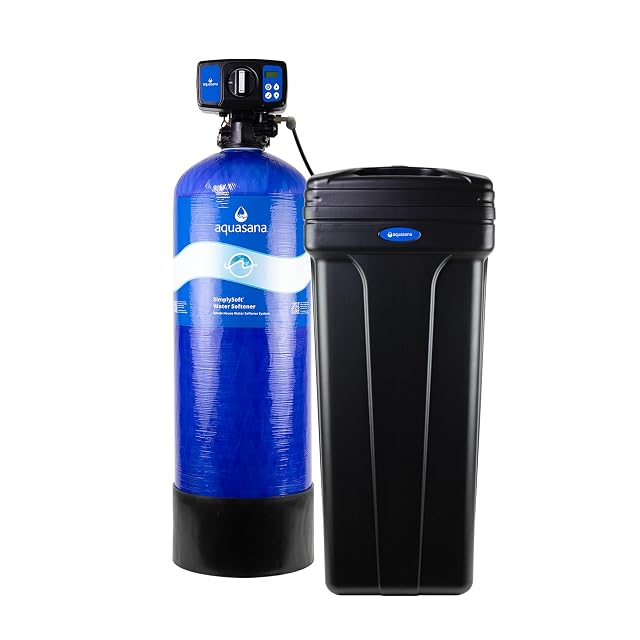
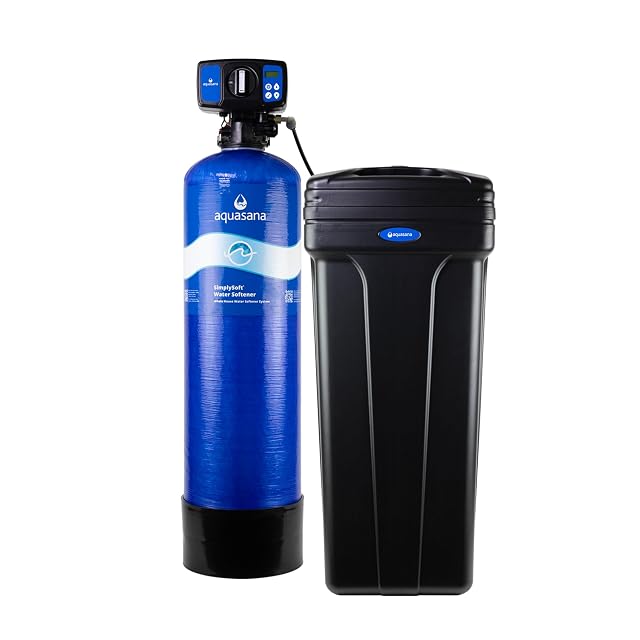
And saving hundreds of gallons of water has no baseline. Aquasana, on this shelf, publishes 28% less water than a time-based softener. That is the form the claim should take.
Availability
Available at around $679.99 on Amazon.com when we checked on October 29, 2026, for delivery to a US address.
Stock and prices on Amazon.com move without notice; the button above opens the live listing.
Prices quoted in this text were read on October 29, 2026. The live price is at the top of the page.
The questions we get
Why does naming PFAs matter?
Because they are the contaminant class that has driven American drinking-water regulation in recent years, and because almost nobody puts them in writing. Per- and polyfluoroalkyl substances are persistent industrial chemicals, and granular activated carbon is one of the accepted treatments for them. This is the only listing on this shelf that names them — the maker’s own 48,000-grain model lists chlorine, VOCs and pesticides and does not mention PFAs. Note that the pre-filter does the work, not the softener: ion exchange removes hardness, not organic chemicals.
Is the stainless steel claim significant?
It is a difference in how Aquasure describes this model. Its 32,000, 48,000 and 64,000 grain listings all say "fiberglass-lined polyethylene tank"; this one says "corrosion-resistant, stainless steel". A stainless jacket over a composite tank is common at this level and the listing does not say which part is steel. Worth asking, because a fiberglass-lined polyethylene tank is the normal and perfectly good construction for a softener — the claim here is a difference in words that may or may not be a difference in the product.
Fifty thousand grains or sixty-four?
If headroom allows, the 64,000 — $749.99 against $679.99, which is $11.72 a thousand grains against $13.60, and 14,000 more grains for seventy dollars. What this model has that the 64,000 does not is the pre-filter, which protects the resin from chlorine and matters on municipal water. And it is 48 in (1219 mm) tall against 1524: three hundred millimeters of ceiling, which in a lot of basements decides it.