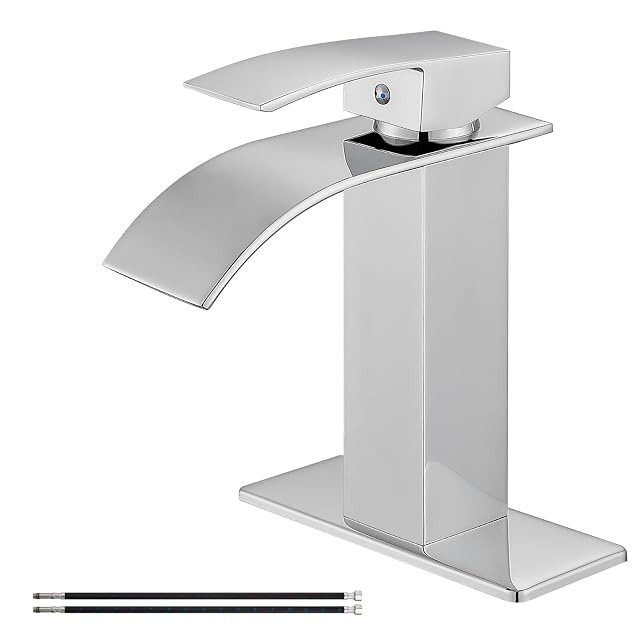
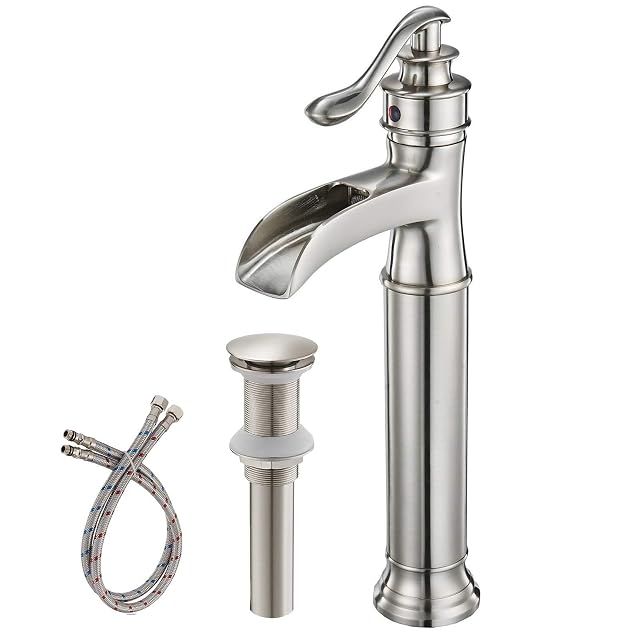
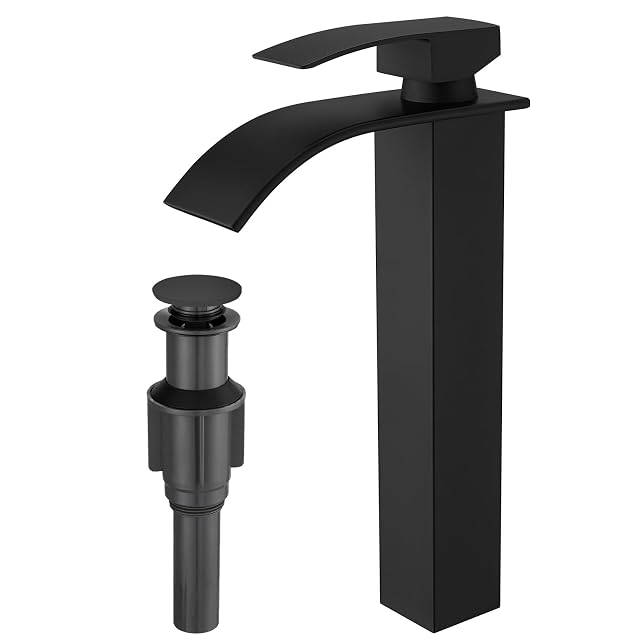
What the maker puts in writing
- “Temperature sensitive faucet… Blue light ≤80°F (26.7°C), green light 80°F (26.7°C)-110°F (43.3°C), red light≥ 110°F (43.3°C). The LED light activates upon normal faucet operation… Build-in temperature sensitive LED lights powered by water flow, so there’s no need for batteries or outlets”
- “Wide spout makes water comes out like beautiful waterfall. Equipped with faucet aerator, 30% water can be saved”
- “Features a built-in 35 mm high density drip-free ceramic disc valve cartridge… It passed 60W times of open+close test at 90 degrees, without water leakage. Excellent PVD electroplating… Constructed with H59 brass, lead-free”
- “LED faucet can be installed on one or three holes 4 inch center sink with the (included) optional 6.3” deck plate… The faucet is made of solid 304 stainless steel with matte black plated. Complete the look of your sink with the included pop-up drain assembly and optional deck plate”
- “AVSIILE LED Faucet helps to save water by indicating temperature instead of allowing the water to run and stopping to check temperature as it heats”
Red begins at a hundred and ten
That is the number that makes this more than a novelty.
Blue below 80 °F. Green from 80 to 110. Red at 110 °F and above.
A hundred and ten Fahrenheit is above comfortable and below the point at which an adult scalds quickly — but a small child’s skin burns faster than an adult’s, and so does the skin of anyone whose sensation has been dulled by age or diabetes.
A stream that turns red before anyone touches it is a warning that works without feeling, and it works for a child who cannot read a dial.
Nothing else on this shelf offers it.
And it runs off the water
Powered by water flow, so there’s no need for batteries or outlets.
This is the detail that decides whether a lighted faucet is still lit in three years.
A battery compartment under a sink is a damp battery compartment, and an AC-powered faucet needs an outlet where there is no outlet. A small turbine in the flow needs neither.
The one honest water-saving argument on this shelf
Two faucets here claim to save water, and only one of them makes sense.
Fransiton attributes 20% to a cartridge cycle test, which measures durability and nothing else.
AVSIILE attributes 30% to an aerator, which physically mixes air into the stream and reduces the volume passing through. That is how water saving actually works.
And then the second argument, which is better still: helps to save water by indicating temperature instead of allowing the water to run and stopping to check temperature as it heats.
Everybody does that. Everybody runs a bathroom faucet for twenty seconds with a hand in it, waiting. A faucet that shows the temperature from across the room removes the wait.
Bullet three: Constructed with H59 brass, lead-free.
Bullet four: The faucet is made of solid 304 stainless steel.
H59 is a real brass. Three-oh-four is a real stainless. Both are plausible for a faucet, and a faucet is not made of both.
The lead-free claim is the one worth having in writing, because this is water people drink. Ask which.
It passed 60W times of open+close test at 90 degrees.
“60W times” is not a number in English.
It may well mean 600,000, which would match the Fransiton’s published figure on this shelf and beat the RUMOSE’s 500,000. But that is a guess about a translation, and a guess is not a specification.
What is not here
No flow rate — odd on the one faucet that claims a percentage saving. The Airuida here publishes 1.2 GPM.
No warranty, where RUMOSE publishes a limited lifetime for $11.50 less.
Availability
Available at around $49.49 on Amazon.com when we checked on October 29, 2026, for delivery to a US address.
Stock and prices on Amazon.com move without notice; the button above opens the live listing.
Prices quoted in this text were read on October 29, 2026. The live price is at the top of the page.