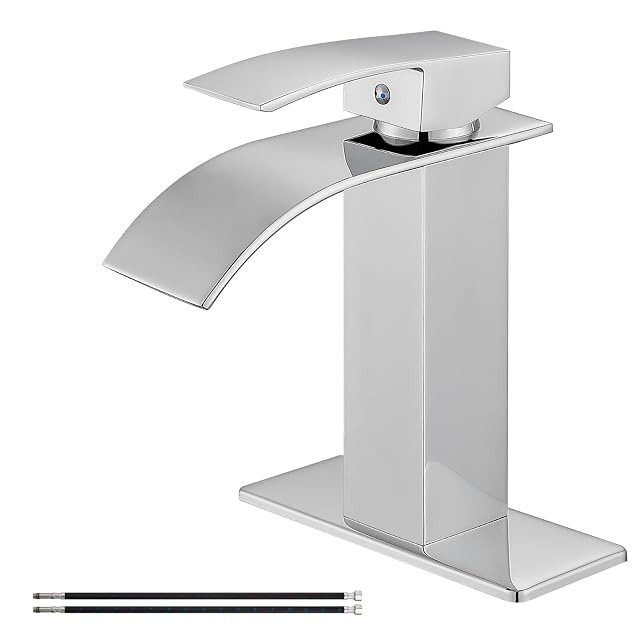
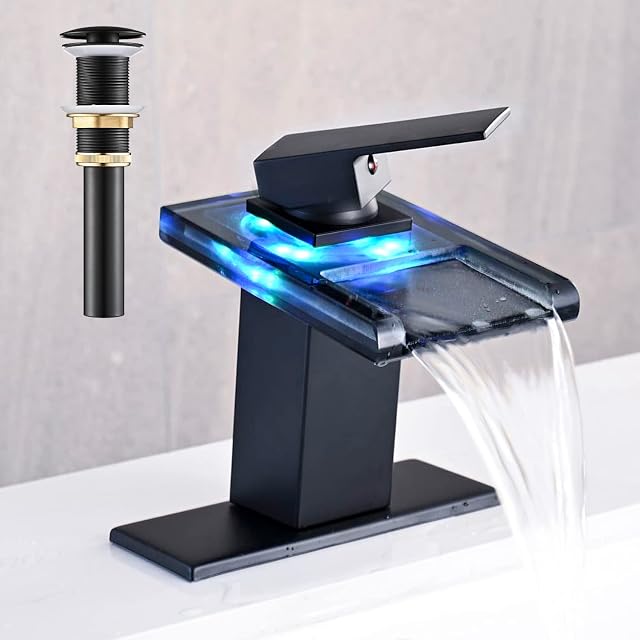
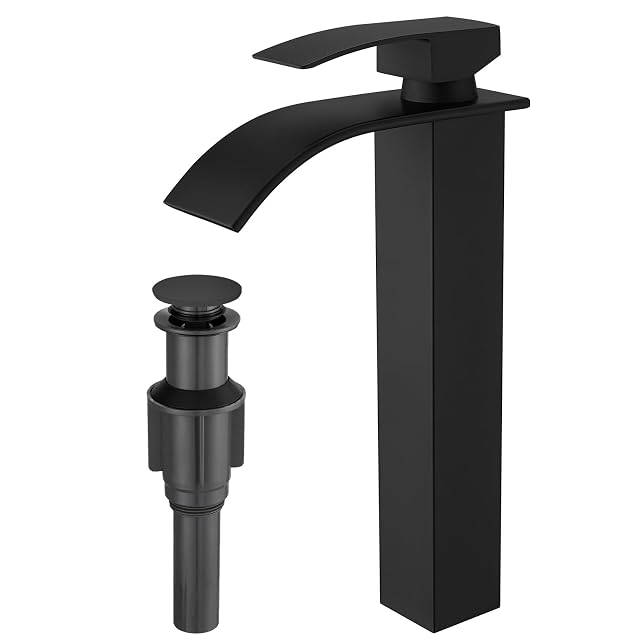
What the maker puts in writing
- “Vessel sink faucet provides clear and steady laminar water flow, which provides a beautiful water presentation. Single lever handle design is easy to control the flow and temperature”
- “Solid brass tall bathroom faucet heavy duty material construction for reliable and durable. The cartridge adopts ceramic sealing technology, reduce leaking points and provide smooth water flow”
- With one-hole installation, compatible with most bathroom sinks and vanities
- A single handle controlling both temperature and water flow
- “With 2 standard 3/8” (approx. 1.9 cm (0.7 in)) water lines, pop-up drain. This single-hole bathroom faucet is easy to install and clean”
Laminar
One word, and it is the reason this faucet exists.
Laminar flow is water moving as a smooth unbroken column with no air in it — glass-clear, so you can see straight through the falling sheet.
An aerated stream, which is what most bathroom faucets give and what the AVSIILE on this shelf explicitly gives, has air beaten into it. The water goes white and soft, splashes less, and uses less.
On a shelf named for waterfall faucets, that is the real choice, and only two of these six listings say which one they do.
If the point of a waterfall spout is to watch clear water fall into a bowl, laminar is what produces it. Aerated looks like milk.
And the honest trade attached to it
Laminar flow is all water. An aerator pads the volume out with air so that a thin stream feels full — which is precisely how a 1.2 GPM faucet manages to feel adequate.
BWE publishes no flow rate, so there is no number to put on this. The Airuida on this shelf publishes 1.2 GPM, the Californian limit for a lavatory faucet.
If a flow figure has to be shown to a landlord or an inspector, this listing has none.
Solid brass, said plainly
Which is worth noting on this shelf, because the AVSIILE claims H59 brass in one bullet and 304 stainless in the next, and three other listings here say stainless.
Brass is the traditional faucet material: it casts and machines cleanly, it takes a plating well, and a brass body can be stripped and rebuilt. The question brass raises is lead, and this listing does not address it — where AVSIILE at least claims lead-free in one of its two contradictory bullets.
Three-eighths of an inch
2 standard 3/8” water lines.
That is the American sink stub size, and it is the only listing on this shelf whose connection needs nothing explained.
Fransiton publishes a 9/16 inch connection. Airuida publishes 3/8 female compression by M10 male — metric at the faucet end. Neither is a problem with the right hoses, and both are a second trip if you assume.
What seventy-seven dollars does not buy
No warranty. The most expensive faucet on this shelf publishes none, where the RUMOSE gives a limited lifetime at $37.99 and the Fransiton a year at $26.99.
No cycle test, where Fransiton publishes 600,000 and RUMOSE 500,000.
No height figure, on a faucet sold as tall and for a vessel sink — the RUMOSE publishes 11.8 in (300 mm) for the same job.
No mounting hole size, so “compatible with most bathroom sinks” has to be taken on trust.
Five bullets, and the first word of the first one is the best thing on the page.
Availability
Available at around $72.95 on Amazon.com when we checked on October 29, 2026, for delivery to a US address.
Stock and prices on Amazon.com move without notice; the button above opens the live listing.
Prices quoted in this text were read on October 29, 2026. The live price is at the top of the page.
The questions we get
What is laminar flow and why does it matter here?
It is water moving as a smooth, unbroken column with no air mixed into it — glass-clear, so you can see through it. An aerated stream, which is what most bathroom faucets and the AVSIILE on this shelf produce, has air whipped into it: the water looks white and soft, splashes less and uses less. On a shelf named for waterfall faucets, this is the real aesthetic split, and only two of the six listings say which they do. If the reason you want a waterfall spout is to watch a sheet of clear water fall into the bowl, laminar is the one that does it. Aerated looks like milk.
Does laminar flow use more water?
For the same visible stream, generally yes, and that is the honest trade. An aerator pads the volume out with air, so a thin flow looks full — which is exactly how a 1.2 GPM faucet feels adequate. Laminar flow is all water. BWE publishes no flow rate, so there is no figure to put on it; the Airuida on this shelf publishes 1.2 GPM, the Californian limit for a bathroom faucet. If a flow figure has to be shown to anyone, this listing cannot provide one.
Is $72.95 justified?
On what is published, it is hard to argue. The listing gives solid brass, a ceramic cartridge, laminar flow, 3/8 inch lines and a drain — all good, none of it quantified. For $37.99 the RUMOSE publishes a 500,000-cycle valve, a 11.8 in (300 mm) height, and a limited lifetime warranty. For $26.99 the Fransiton publishes 600,000 cycles, a hole size, a deck thickness limit and a one-year warranty. What this has that neither has is the word brass and the word laminar, and for a vessel sink where the water is on show that may be exactly what you came for.