What the maker puts in writing
- “CODE COMPLIANT BOTTLE TRAP: Meets plumbing code requirements in USA/CAN ; 1-1/4” inch slip inlet and 1-5/8” joint out. smooth interior won’t cause buildup or bad odors… suitable for all standard pop-up wastes, Works for all types of bathroom sinks: Undermount, Vessel Sinks and Pedestal Sinks with & without Overflow”
- “Complete Kit includes all drainage parts needed… No special tools needed”; stated at 15 minutes
- “Triple brass sealing rings embedded inside ensure water seal integrity. Odor Seal Prevents bad smells and leaks even when you adjust the extension pipe height”
- “Lead-free zinc brass alloy build to resist daily scratches, corrosions and tarnishing”; multi-layer chrome finish
- “18 MONTH WARRANTY: If you encounter any fitment or quality issue within 18 months, we will make it right”
The only code claim on this shelf
Meets plumbing code requirements in USA/CAN.
On a trap that is not a formality, because a trap is a health fixture. The water standing in it is the only thing between a bathroom and a sewer, and that is why codes specify how deep the seal must be and which shapes are acceptable.
It matters more on a bottle trap than it would on a plain P-trap, because a bottle trap holds its water in a shallower annular space than a deep U-bend does, and codes treat the two differently.
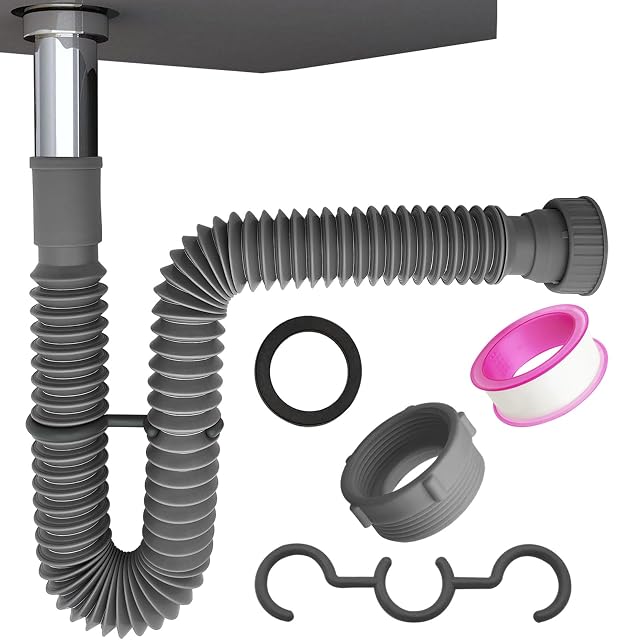
So the claim is doing real work, and nothing else on this shelf makes one — including the flexible trap whose own reference says S-trap, a shape modern codes do not accept.
What is missing is the seal depth itself, which is the figure a code is written around. If the job will be inspected, ask.
A smooth interior, which is the opposite of the flexible trap
Smooth interior won’t cause buildup or bad odors.
Read that directly against the TGEOND on this shelf, whose concertina wall is a stack of internal ridges that catch hair and soap until the sink runs slow.
A trap is a place where water changes direction and slows down. The one thing you want on its inside surface is nothing at all.
And what a bottle trap is actually for
Being seen.
A P-trap is a U-bend out to the wall. A bottle trap is a vertical chrome cylinder: water enters a central tube, goes down inside it, and rises around it before leaving through the side.
Which makes it compact, symmetrical and good-looking — so it is the fitting for a vessel sink or a pedestal sink, where there is no cabinet door to hide the plumbing.
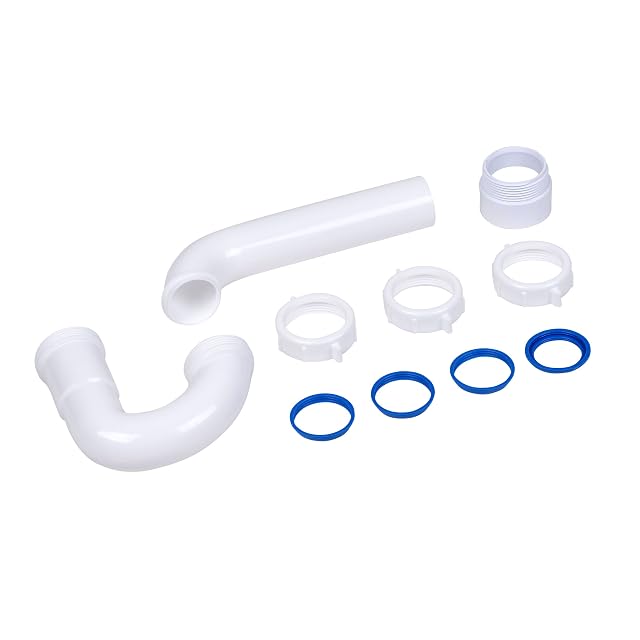
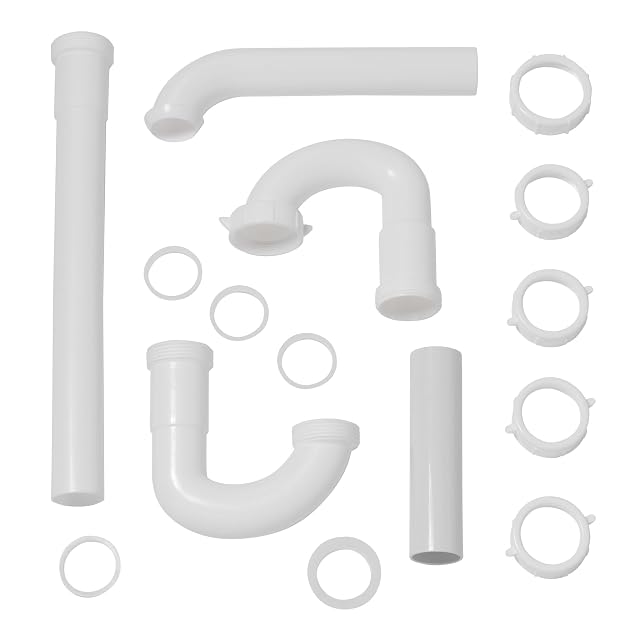
Under a vanity, where nobody looks, a P-trap is cheaper and holds a deeper seal. The Oatey on this shelf is $9.00.
Three seals, and height that adjusts
Triple brass sealing rings embedded inside… even when you adjust the extension pipe height.
That second clause is the useful one. A visible trap has to meet the sink above and the wall stub behind, and the two are rarely the exact distance apart that any fixed fitting assumes.
An adjustable extension that keeps its seal while being adjusted is the difference between a trap that fits and one that nearly fits.
The material, honestly
Lead-free zinc brass alloy with multi-layer chrome.
Chrome is plated over a base metal, and the base metal decides how a chip ages. Over brass, a chip shows yellow metal that corrodes slowly. Over zinc alloy, it shows a metal that corrodes fast and lifts the chrome around it — so one small chip spreads into a gray patch.
Under a cabinet that would not matter. On a trap bought specifically to be looked at, the finish is the product.
Treat it gently, never use abrasive cleaner on it, and note that eighteen months of warranty is more than anything else on this shelf offers.
Availability
Available at around $21.50 on Amazon.com when we checked on October 29, 2026, for delivery to a US address.
Stock and prices on Amazon.com move without notice; the button above opens the live listing.
Prices quoted in this text were read on October 29, 2026. The live price is at the top of the page.